<?xml version="1.0" encoding="UTF-8"?>
<?xml-stylesheet type="text/xsl" href="/stylesheets/feed.atom.xml" media="screen"?>
<feed xml:lang="en-US" xmlns="http://www.w3.org/2005/Atom">
  <id>tag:simonettilab.nd.edu,2005:/news</id>
  <link rel="alternate" type="text/html" href="https://simonettilab.nd.edu"/>
  <link rel="self" type="application/atom+xml" href="https://simonettilab.nd.edu/news.atom"/>
  <id>tag:simonettilab.nd.edu,2005:/latest</id>
  <title>Isotope Geochemistry | News</title>
  <updated>2025-04-02T16:00:00-04:00</updated>
  <link rel="alternate" type="text/html" href="https://simonettilab.nd.edu/"/>
  <link rel="self" type="application/atom+xml" href="https://simonettilab.nd.edu//news.atom"/>
  <subtitle>ND's Isotope Geochemistry Lab specializes in isotopic and chemical forensic analyses of natural and anthropogenic materials for source attribution purposes.</subtitle>
  <entry>
    <id>tag:simonettilab.nd.edu,2005:News/172908</id>
    <published>2025-04-02T16:00:00-04:00</published>
    <updated>2025-05-28T16:00:32-04:00</updated>
    <link rel="alternate" type="text/html" href="https://simonettilab.nd.edu/news/journey-to-a-land-of-extremes-civil-engineering-students-explore-death-valley/"/>
    <title>Journey to a land of extremes: Civil engineering students explore Death Valley</title>
    <summary type="text">
      <![CDATA[Over spring break, 14 Notre Dame civil engineering students, one teaching assistant, and two professors traveled from snowy Northwest Indiana to the hot and arid Southwest to explore Death Valley’s stunning and complex geology. What follows is a student travelogue of their experiences. …]]>
    </summary>
    <content type="html">
      <![CDATA[<p>Over spring break, 14 Notre Dame civil engineering students, one teaching assistant, and two professors traveled from snowy Northwest Indiana to the hot and arid Southwest to explore Death Valley’s stunning and complex geology. What follows is a student travelogue of their experiences.</p>
<section class="wp-block-uagb-columns uagb-columns__wrap uagb-columns__background-none uagb-columns__stack-mobile uagb-columns__valign-center uagb-columns__gap-10 align uagb-block-724e24be uagb-columns__columns-2 uagb-columns__max_width-custom not-in-view in-view">
<div class="uagb-columns__inner-wrap uagb-columns__columns-2">
<div class="wp-block-uagb-column uagb-column__wrap uagb-column__background-undefined uagb-block-14605b15">
<p><em>We left campus at 4:30 a.m. on March 9th for a flight from Chicago to Las Vegas.</em></p>
<p><em>On our first day, we toured the Hoover Dam, descending more than 50 floors to the dam’s tunnels and power plants. Despite being sleep-deprived from a long day of travel, we were awe-struck by the sheer scale of the dam and the power of civil engineering.</em></p>
<p><em>We left Vegas the next day and drove to Death Valley National Park, where we would spend the next three days exploring. Our adventures began in the area surrounding Death Valley, examining the relatively recent 10-million-year-old volcanic rocks (that included fresh obsidian!) near Shoshone, NV. We then proceeded to Badwater Basin—the lowest spot in the continental Americas, sitting at about 282 feet below sea level.</em></p>
<p><em>We walked out onto the basin’s stark, white, salt flats. Telescope Peak and the snow-capped Panamint mountain range towered above us, and we reeled from the sheer vastness of the landscape. We dared one another to taste the salt. It was like sea salt—but worse. </em></p>
<p><em>We did five hikes within the park—Mosaic Canyon, Keane Wonder Mine, Golden Canyon (which ended at Zabriskie Point), Fall Canyon, and Natural Bridge. We made two additional stops at the Mesquite Sand Dunes and Ubehebe Crater to explore.</em></p>
<p><em>We all kept field journals during the trip to write down coordinates, sketch rock formations, and record strike and dip measurements with our Brunton compasses—a skill we learned on the trip, essential in determining the orientation of rock layers and deciphering their complex tectonic history. </em></p>
<p><em>The Natural Bridge hike brought us into a canyon, where we could view and sketch formations of the metamorphic rock, gneiss, around 1.7-2.5 billion years old—the oldest rocks in Death Valley. On the Keane Wonder Mine hike, we searched near an old gold mine for garnet-bearing samples in the metamorphic rocks, but with little success. </em></p>
<p><em>On Thursday, we packed up and left the small town of Beatty, Nevada. We were sad to leave the wild burros that roamed the town.</em></p>
<p><em>On our way to Vegas, we stopped at the Valley of Fire State Park, known for its brilliant red-orange sandstone. We hiked the White Domes, Elephant Rock and Mouse’s Tank trails, where we saw petroglyphs created by a culture known as the Basketmakers (2000-1450 years ago) and the Anasazi/Ancient Pueblo group (1500-850 years ago), who once inhabited that land. </em></p>
<p><em>After we retuned to Las Vegas, we washed the rental cars, completed a field assignment, and got ready for our flight home.</em></p>
<p><em>In the classroom, we had learned about this area’s geology but being able to experience it in the natural world was spectacular.</em></p>
</div>
</div>
</section>]]>
    </content>
    <link rel="enclosure" type="image/jpeg" href="https://simonettilab.nd.edu/assets/618009/ceees_hero.jpg" title="Spring break 2025 field trip group picture, Golden Canyon, Death Valley NP"/>
    <author>
      <name>Sarah Oliva ’26, Shannon Dorman ’27, Nick May ’26</name>
    </author>
  </entry>
  <entry>
    <id>tag:simonettilab.nd.edu,2005:News/172910</id>
    <published>2023-08-18T16:07:00-04:00</published>
    <updated>2025-05-28T16:07:45-04:00</updated>
    <link rel="alternate" type="text/html" href="https://simonettilab.nd.edu/news/notre-dame-receives-nautilus-a-one-of-a-kind-system-for-materials-analysis-from-us-navy/"/>
    <title>Notre Dame receives NAUTILUS, a one-of-a-kind system for materials analysis, from US Navy</title>
    <summary type="text">
      <![CDATA[The United States Navy has transferred NAUTILUS, a one-of-a-kind system for materials analysis, to the University of Notre Dame.]]>
    </summary>
    <content type="html">
      <![CDATA[<figure class="image-default"><img src="https://news.nd.edu/assets/527665/fullsize/nrl_signing_1000.jpg" alt="Nrl Signing 1000" width="1000" height="563">
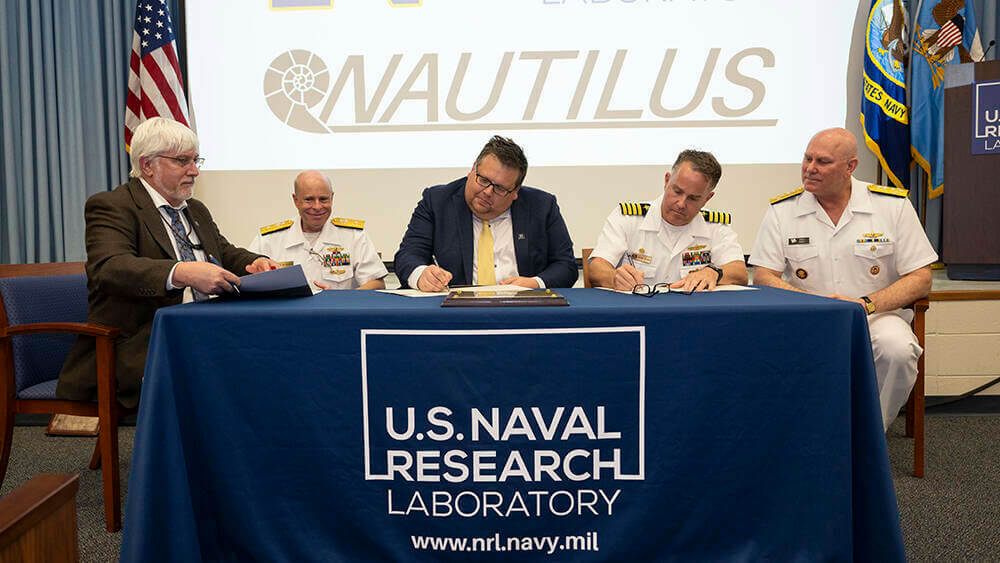
<figcaption>Bruce Danly (left), U.S. Naval Research Laboratory director of research, Capt. Jesse Black (center-right), NRL commanding officer, and Jeff Rhoads (center), Notre Dame vice president for research, sign an Education Partnership Agreement transferring NRL’s NAUTILUS instrument to Notre Dame during an event in Washington, D.C.  The NAUTILUS provides measurement capabilities for research in atomic mass spectrometry. (U.S. Navy photo by Sarah Peterson)</figcaption>
</figure>
<p> </p>
<p>The United States Navy has transferred <a href="https://pubs.rsc.org/en/content/articlelanding/2020/ja/c9ja00344d">NAUTILUS</a>, a one-of-a-kind system for materials analysis, to the University of Notre Dame. The transfer occurred during a ceremony held at the Naval Research Laboratory in Washington, D.C.</p>
<p><a href="https://research.nd.edu/people/jeffrey-rhoads/">Jeffrey F. Rhoads</a>, vice president for research and professor in the <a href="https://ame.nd.edu/">Department of Aerospace and Mechanical Engineering</a>, said, “We are so grateful for our long-standing relationship with the United States Navy. For over 80 years, we have worked together with a shared mission to serve our country and its people, and today is just another example of Notre Dame and the Navy working together to drive innovation for the betterment of the United States.”</p>
<p>Rhoads added that “the transfer of NAUTILUS to our campus in South Bend is not only a generous gift, but it will be an impactful one. At Notre Dame, our researchers will steward it well, using it to explore and discover new knowledge as they advance their research and lean into our research ethos of doing good in the world.”</p>
<p>The name NAUTILUS stands for NAval Ultra-Trace Isotope Laboratory Universal Spectrometer. Unlike other spectrometers, NAUTILUS combines two separate processes for materials analysis. It uses secondary ion mass spectrometry (SIMS) analysis along with single-stage accelerator mass spectrometry (SSAMS). The addition of SSAMS makes NAUTILUS over 10 times more sensitive than commercial SIMS instruments.</p>
<p><a href="https://physics.nd.edu/people/philippe-collon/">Philippe Collon</a>, professor and associate chair in the <a href="https://physics.nd.edu/">Department of Physics and Astronomy</a>, explained, “NAUTILUS excels at detecting impurities in a material. It enables what you might call ‘needle in a haystack’ work. But instead of a needle in a haystack, imagine detecting a single bottle of pollutants poured into Lake Michigan — then you have an idea of the kind of extremely precise analysis this instrument is capable of.”</p>
<p>NAUTILUS’ unique capabilities will augment the University’s existing research expertise. As part of one of the world’s longest-running particle accelerator research programs, Notre Dame currently operates several low-energy accelerators.</p>
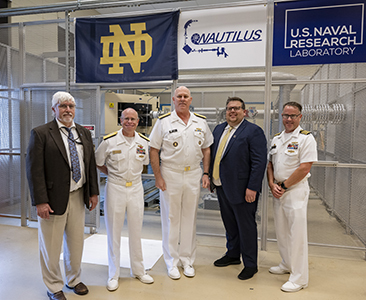
<figure class="image-right"><img src="https://news.nd.edu/assets/527664/366x300/nrl_group_shot_366.jpg" alt="Nrl Group Shot 366" width="366" height="300">
<figcaption>Capt. Jesse Black (right), U.S. Naval Research Laboratory commanding officer, Bruce Danly (left), NRL director of research, Chief of Naval Research Rear Adm. Kurt Rothenhaus (center-left), Vice Chairman, Joint Chiefs of Staff Adm. Christopher W. Grady (center), and Jeff Rhoads (center-right),  University of Notre Dame vice president for research,  during an event to transfer NRL’s NAUTILUS instrument to Notre Dame in Washington, D.C. on Aug. 18. The NAUTILUS measures nuclear, cosmo/geo-chemical and electronic materials. (U.S. Navy photo by Sarah Peterson)</figcaption>
</figure>
<p>By transferring NAUTILUS from the Naval Research Laboratory in Washington, D.C., to South Bend, the U.S. Navy will foster collaborative research with Notre Dame faculty members while also making new connections with other universities and national laboratories that will be able to now use NAUTILUS at the University.</p>
<p>“This transfer, authorized by Congress and facilitated through educational partnership agreements, is more than a mere exchange of equipment,” said Adm. Christopher Grady, vice chairman of the Joint Chiefs of Staff and a 1984 Notre Dame graduate. “It is a commitment to fostering further innovation and research that can be applied to Naval and national security challenges, enhancing collaboration between government and academia and strengthening America’s competitive advantage in the global scientific arena.”</p>
<p>Notre Dame researchers said they plan to integrate NAUTILUS into several existing research projects.</p>
<p>For example, <a href="https://physics.nd.edu/people/philippe-collon/">Collon</a> will use NAUTILUS to understand the processes that formed our solar system, while <a href="https://engineering.nd.edu/faculty/clive-neal/">Clive Neal, a professor</a> in the <a href="https://ceees.nd.edu/">Department of Civil and Environmental Engineering and Earth Sciences</a>, will use NAUTILUS to bring a new dimension to his lunar samples. <a href="https://engineering.nd.edu/faculty/amy-e-hixon/">Amy Hixon</a> and <a href="https://engineering.nd.edu/faculty/antonio-simonetti/">Antonio Simonetti</a>, both associate professors in the <a href="https://ceees.nd.edu/">Department of Civil and Environmental Engineering and Earth Sciences</a>, will use NAUTILUS to test samples from the Ewing Mineral Collection at Notre Dame.</p>
<p>Once NAUTILUS is operational in its new home on Notre Dame’s main campus, it will be the center of a new University-wide research facility managed by the <a href="https://science.nd.edu/">College of Science</a>, the <a href="https://engineering.nd.edu/">College of Engineering</a> and <a href="https://research.nd.edu/">Notre Dame Research</a>. Researchers from the <a href="https://isnap.nd.edu/about/">Institute for Structure and Nuclear Astrophysics (ISNAP)</a> and <a href="https://energy.nd.edu/">ND Energy</a> will serve as frequent collaborators, and NAUTILUS will also be available to research groups from outside the University.</p>
<p>According to Collon, some of the biggest benefits of NAUTILUS’ presence at Notre Dame will be for students.</p>
<p>“The next generation of STEM researchers are going to be tasked with doing a more careful analysis of material with smaller and smaller samples to detect things like very advanced forgeries, for example. Students who work with NAUTILUS can learn a comprehensive set of techniques — how to understand ion optics, how to run an accelerator, how to analyze its data and how to optimize tests. That is training we will now be able to offer to our undergraduate and graduate students using this one very advanced piece of equipment.”</p>
<p>To learn more about nuclear science at Notre Dame, visit <a href="https://isnap.nd.edu/">isnap.nd.edu</a>.</p>
<p> </p>
<p class="attribution">Originally published by <span class="rel-author">Brett Beasley</span> at <span class="rel-source"><a href="https://news.nd.edu/news/notre-dame-receives-nautilus-a-one-of-a-kind-system-for-materials-analysis-from-us-navy/">news.nd.edu</a></span> on <span class="rel-pubdate">August 18, 2023</span>.</p>]]>
    </content>
    <link rel="enclosure" type="image/jpeg" href="https://simonettilab.nd.edu/assets/618010/nrl_signing_1000.jpg" title="Nrl Signing 1000"/>
    <author>
      <name>Brett Beasley</name>
    </author>
  </entry>
  <entry>
    <id>tag:simonettilab.nd.edu,2005:News/171654</id>
    <published>2022-04-22T15:23:00-04:00</published>
    <updated>2025-04-14T15:25:06-04:00</updated>
    <link rel="alternate" type="text/html" href="https://simonettilab.nd.edu/news/a-walk-through-the-valley-of-death-notre-dame-geologists-study-rocks-and-earth-tectonics-in-southwest-desert/"/>
    <title>A Walk Through the Valley of Death: Notre Dame geologists study rocks and Earth tectonics in southwest desert</title>
    <summary type="text">
      <![CDATA[Sydney Higgins was trying to make sense of the readings from her Brunton compass at Red Rock Canyon near Las Vegas. Geologist Tony Simonetti had taught his Planet Earth students how to take strike and dip measurements in the…]]>
    </summary>
    <content type="html">
      <![CDATA[<p>Sydney Higgins was trying to make sense of the readings from her Brunton compass at Red Rock Canyon near Las Vegas.</p>
<p>Geologist <a href="https://engineering.nd.edu/faculty/antonio-simonetti/">Tony Simonetti</a> had taught his Planet Earth students how to take strike and dip measurements in the classroom, but now a theory had turned into reality. He poured water on the angled rock mountainside to identify the exact direction of the dip angle, which reveals the strike plane in a perpendicular direction.</p>
<p>“Doing it in the field is so much more …,” said Higgins, searching for the right word. “I’m a very hands-on learner, so it just made me understand.”</p>
<p>Taking strike and dip readings, Simonetti said, helps a geologist understand a region’s tectonic history — the massive underground forces that thrust up the mountains and stretched out the valleys over millions of years. Seeing firsthand the results of these tectonic plate collisions is exactly why the associate professor in the Department of Civil and Environmental Engineering and Earth Sciences (<a href="https://ceees.nd.edu/">CEEES</a>) took 16 undergraduates and two graduate students to <a href="https://www.nps.gov/deva/index.htm">Death Valley National Park</a> and Red Rock Canyon for a one-credit field trip over spring break.</p>
<p>To read the story, click <a href="https://www.nd.edu/stories/a-walk-through-the-valley-of-death/">here</a>.</p>
<p class="attribution">Originally published by <span class="rel-author">Brendan O'Shaughnessy</span> at <span class="rel-source"><a href="https://news.nd.edu/news/a-walk-through-the-valley-of-death-notre-dame-geologists-study-rocks-and-earth-tectonics-in-southwest-desert/">news.nd.edu</a></span> on <span class="rel-pubdate">April 22, 2022</span>.</p>]]>
    </content>
    <link rel="enclosure" type="image/jpeg" href="https://simonettilab.nd.edu/assets/612908/death_valley_1200.jpg" title="A Civil and Environmental Engineering and Earth Sciences student hikes through Natural Bridge Canyon in Death Valley National Park."/>
    <author>
      <name>Brendan O'Shaughnessy</name>
    </author>
  </entry>
  <entry>
    <id>tag:simonettilab.nd.edu,2005:News/171657</id>
    <published>2018-03-16T15:42:00-04:00</published>
    <updated>2025-04-14T15:43:14-04:00</updated>
    <link rel="alternate" type="text/html" href="https://simonettilab.nd.edu/news/researchers-uncover-most-complex-mineral-on-earth/"/>
    <title>Researchers uncover most complex mineral on Earth</title>
    <summary type="text">
      <![CDATA[Researchers at Notre Dame found that the complexity of a uranium-based mineral, dubbed ewingite, is nearly twice as high as the previous most complex mineral. The study, published in Geology, required the use of the Advanced Photon Source at the U.S. Department of Energy’s Argonne National Laboratory, the brightest X-ray source in the Western Hemisphere, to define the mineral’s structure.]]>
    </summary>
    <content type="html">
      <![CDATA[<p style="text-align: justify; margin: 0in 0in 10pt 0in;"><span style="text-justify: inter-ideograph;">Researchers at the University of Notre Dame found that the complexity of a uranium-based mineral, dubbed ewingite, is nearly twice as high as the previous most complex mineral. The study, published in <a href="https://pubs.geoscienceworld.org/gsa/geology/article/45/11/1007/516675/ewingite-earth-s-most-complex-mineral">Geology</a><em>, </em>required the use of the Advanced Photon Source at the U.S. Department of Energy’s Argonne National Laboratory, the brightest X-ray source in the Western Hemisphere, to define the mineral’s structure.</span></p>
<p style="text-align: justify; margin: 0in 0in 10pt 0in;"><span style="text-justify: inter-ideograph;">According to <a href="https://engineering.nd.edu/profiles/pburns">Peter C. Burns</a>, Henry J. Massman Professor of <a href="https://ceees.nd.edu/">Civil and Environmental Engineering and Earth Sciences</a>, director of the <a href="https://energy.nd.edu/">Center for Sustainable Energy</a> at Notre Dame and co-author of the study, structural complexity of minerals can be measured by bits per unit cell. The average is about 228 bits. </span></p>
<p style="text-align: justify; margin: 0in 0in 10pt 0in;"><span style="text-justify: inter-ideograph;">“Minerals at 1,000 bits are considered very complex, but only about 2.5 percent of known minerals receive that designation,” said Burns. “In comparison, ewingite measures at 12,684.86 bits per unit cell, essentially doubling the measuring stick that mineralogists currently use.”</span></p>
<p style="text-align: justify; margin: 0in 0in 10pt 0in;"><span style="text-justify: inter-ideograph;">Ewingite was found on a damp mine wall in the Czech Republic and was in the same region where uranium ore was mined for Marie Curie’s groundbreaking studies of radioactivity a century ago. Curie’s studies resulted in the discoveries of the elements polonium and radium, which had been in the rocks for a long period of time. Ewingite had likely only grown over decades, after humans began interacting with the mine. </span></p>
<p style="text-align: justify; margin: 0in 0in 10pt 0in;"><span style="text-justify: inter-ideograph;">“Humans have done a pretty good job at interfering with the planet’s natural processes by digging into Earth’s surface and releasing chemicals into the atmosphere,” Burns said. “Our next step with this research is to confirm whether or not this extremely complex mineral could have even existed if humans had not opened and exposed the mine to air and water. This is important for understanding what effect human involvement is having on Earth’s other geological processes.”</span></p>
<p style="text-align: justify; margin: 0in 0in 10pt 0in;"><span style="text-justify: inter-ideograph;">Burns and his team are working with the Carnegie Institute to gather all existing data on uranium-based minerals to see if they can find variations between minerals that may or may not have been impacted by human existence. Additionally, the Burns lab is attempting to recreate the mineral to better understand the conditions that led to its formation.</span></p>
<p style="text-align: justify; margin: 0in 0in 10pt 0in;"><span style="text-justify: inter-ideograph;">Ewingite was named in honor of Rodney C. Ewing, Frank Stanton Professor in Nuclear Security at Stanford University, for his contributions to the fields of mineralogy and nuclear science. The study was funded by the U.S. Department of Energy Basic Energy Sciences program and led by Travis A. Olds as a doctoral student at the University of Notre Dame. Olds is now a postdoctoral scholar at Washington State University. </span></p>
<p style="text-align: justify; margin: 0in 0in 10pt 0in;"><span style="text-justify: inter-ideograph;">Contributors to the study include Yu-Sheng Chen of the Center for Advanced Radiation Sources at the University of Chicago; Anthony R. Kampf of the Natural History Museum of Los Angeles County; Jakub Plásil of the Academy of Sciences of the Czech Republic; Luke R. Sadergaski, graduate student of <span class="caps">CEEES</span> at the University of Notre Dame; and <a href="https://simonettilab.nd.edu/people/antonio-simonetti/">Antonio Simonetti</a>, associate professor and director of graduate studies in the Department of <span class="caps">CEEES</span> at the University of Notre Dame. This research team also utilized the Materials Characterization Facility and Midwest Isotope and Trace Elements Research Analytical Center at Notre Dame to conduct the study.</span></p>
<p style="margin: 0in 0in 10pt 0in;"><strong><em>Contact:</em></strong><em> Jessica Sieff, assistant director, media relations, 574-631-3933, <a href="mailto:jsieff@nd.edu">jsieff@nd.edu</a></em></p>
<p class="attribution"><em>Originally published by <span class="rel-author">Brandi Klingerman</span> at <span class="rel-source"><a href="https://news.nd.edu/news/researchers-uncover-most-complex-mineral-on-earth/">news.nd.edu</a></span> on <span class="rel-pubdate">March 07, 2018</span>.</em></p>]]>
    </content>
    <link rel="enclosure" type="image/jpeg" href="https://simonettilab.nd.edu/assets/612909/ewingite_feature.jpg" title="Ewingite Feature"/>
    <author>
      <name>Brandi Klingerman</name>
    </author>
  </entry>
  <entry>
    <id>tag:simonettilab.nd.edu,2005:News/171653</id>
    <published>2017-11-18T15:13:00-05:00</published>
    <updated>2025-04-14T15:15:16-04:00</updated>
    <link rel="alternate" type="text/html" href="https://simonettilab.nd.edu/news/fighting-to-protect-our-country/"/>
    <title>Fighting to Protect Our Country</title>
    <summary type="text">
      <![CDATA[Since 1993, the International Atomic Energy Agency has tracked 2,500 trafficking cases of nuclear material. While there has yet to be a detonation of a dirty bomb, the threat remains present. In the unlikely event of a nuclear attack on American soil, Notre Dame engineering professor Antonio Simonetti makes one thing clear: The perpetrator could and would be found.]]>
    </summary>
    <content type="html">
      <![CDATA[<p><a href="https://fightingfor.nd.edu/2017/fighting-to-protect-our-country/" title="WHAT WOULD YOU FIGHT FOR?">https://fightingfor.nd.edu/2017/fighting-to-protect-our-country/</a></p>]]>
    </content>
    <link rel="enclosure" type="image/jpeg" href="https://simonettilab.nd.edu/assets/612903/dirtybombs_classroom.jpg" title="Dirty bombs classroom setting"/>
    <author>
      <name>Antonio Simonetti</name>
    </author>
  </entry>
  <entry>
    <id>tag:simonettilab.nd.edu,2005:News/171660</id>
    <published>2016-11-09T15:50:00-05:00</published>
    <updated>2025-04-14T15:51:12-04:00</updated>
    <link rel="alternate" type="text/html" href="https://simonettilab.nd.edu/news/geologists-find-key-indicator-of-carbon-sources-in-earths-mantle/"/>
    <title>Geologists find key indicator of carbon sources in Earth's mantle</title>
    <summary type="text">
      <![CDATA[p(image-right). !https://news.nd.edu/assets/217539/antonio_simonetti_200x.jpg(Antonio Simonetti)! Results of a new study led by "Antonio Simonetti":https://engineering.nd.edu/profiles/asimonetti show evidence of varying ratios of boron isotopes in igneous rocks, known as carbonatites, of different ages.]]>
    </summary>
    <content type="html">
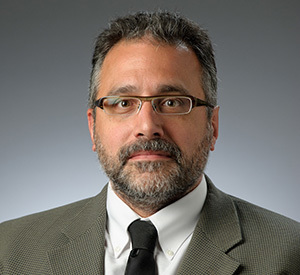
      <![CDATA[<p class="image-right"><img title="Antonio Simonetti" src="https://news.nd.edu/assets/217538/antonio_simonetti_300x.jpg" alt="Antonio Simonetti"></p>
<p>Scientists have found a key indicator in determining whether the presence of carbon, found in the Earth’s mantle, is derived from continental crust – a step toward better understanding the history of crustal formation on Earth’s surface and the rate at which tectonic plates have moved throughout geologic time, which can be linked to the cooling of Earth’s mantle.</p>
<p>Results of a new study published in the journal <a href="http://www.nature.com/ngeo/index.html">Nature Geoscience</a> show evidence of varying ratios of boron isotopes in igneous rocks, known as carbonatites, of different ages. The research was led by <a href="https://engineering.nd.edu/profiles/asimonetti">Antonio Simonetti</a>, associate professor in the <a href="http://ceees.nd.edu/">Department of Civil and Environmental Engineering and Earth Sciences</a> at the University of Notre Dame.</p>
<p>Three theories exist regarding the source of carbon found within the Earth’s mantle: It is of primordial origin, formed during the creation of the planet 4.56 billion years ago; it is a result of planetary collision; or it had been present in marine environments or continental crust, and recycled back into the mantle in areas of subduction, where tectonic plates shifted, one diving beneath the other.</p>
<p>“Our most important finding is that the Boron isotope ratios are highly variable, indicating that the source of carbon within the mantle changed with geological time on Earth,” Simonetti said. Studying the ratios of boron isotopes within carbonatites, researchers are closer to determining which hypothesis applies to specific moments in geological time.</p>
<p>“During the past 4.56 billion years, the subduction rate has varied,” said Simonetti. “Early on, during the first 2 billion years or so, Earth’s mantle was much hotter than it is today, so when subduction did occur, the diving plate did not penetrate as deep into the mantle as it does today because of the higher temperature. During the last 2 billion years or so, a cooler mantle has allowed the subducting plate to dive deeper into the mantle and provide the opportunity to store recycled crustal materials at greater depths, and possibly all the way down to the core-mantle boundary.”</p>
<p>This preliminary investigation into the boron isotope compositions of carbonatites from significant periods in Earth’s history allows Simonetti and his team to monitor long-term temporal variations — creating a clearer picture of crustal formation over time, with the potential to go as far back as several billion years.</p>
<p>The study was co-authored by Samuel R.W. Hulett in the Department of Civil and Environmental Engineering and Earth Sciences at Notre Dame, E. Troy Rasbury of Stony Brook University N. Gary Hemming of Queens College — <span class="caps">CUNY</span>. It appears in <a href="http://www.nature.com/ngeo/journal/vaop/ncurrent/full/ngeo2831.html">Nature Geoscience</a>.</p>
<p><em><strong>Contact</strong>: Antonio Simonetti, 574-631-6710, <a href="mailto:simonetti.3@nd.edu">simonetti.3@nd.edu</a></em></p>
<p class="attribution">Originally published by <span class="rel-author">Jessica Sieff</span> at <span class="rel-source"><a href="https://news.nd.edu/news/geologists-find-key-indicator-of-carbon-sources-in-earths-mantle/">news.nd.edu</a></span> on <span class="rel-pubdate">November 09, 2016</span>.</p>]]>
    </content>
    <author>
      <name>Jessica Sieff</name>
    </author>
  </entry>
  <entry>
    <id>tag:simonettilab.nd.edu,2005:News/171656</id>
    <published>2016-05-06T15:33:00-04:00</published>
    <updated>2025-04-14T15:33:34-04:00</updated>
    <link rel="alternate" type="text/html" href="https://simonettilab.nd.edu/news/simonetti-receives-usgs-service-award/"/>
    <title>Simonetti receives USGS Service Award</title>
    <summary type="text">
      <![CDATA[p(image-right). !https://news.nd.edu/assets/198646/antonio_simonetti_200x150.jpg(Antonio Simonetti)! Antonio Simonetti has been granted the Citizen’s Award for Exceptional Service from the U.S. Geological Survey.]]>
    </summary>
    <content type="html">
      <![CDATA[<p class="image-right"><img title="Antonio Simonetti" src="https://news.nd.edu/assets/198646/antonio_simonetti_200x150.jpg" alt="Antonio Simonetti"></p>
<p>Antonio Simonetti has been granted the Citizen’s Award for Exceptional Service from the U.S. Geological Survey.</p>
<p>Read more: <a href="https://engineering.nd.edu/news-publications/pressreleases/simonetti-receives-usgs-service-award/">https://engineering.nd.edu/news-publications/pressreleases/simonetti-receives-usgs-service-award</a>.</p>
<p class="attribution">Originally published by <span class="rel-author">Nina Welding</span> at <span class="rel-source"><a href="https://news.nd.edu/news/simonetti-receives-usgs-service-award/">news.nd.edu</a></span> on <span class="rel-pubdate">May 06, 2016</span>.</p>]]>
    </content>
    <author>
      <name>Nina Welding</name>
    </author>
  </entry>
  <entry>
    <id>tag:simonettilab.nd.edu,2005:News/172907</id>
    <published>2014-11-28T15:52:00-05:00</published>
    <updated>2025-05-28T15:53:37-04:00</updated>
    <link rel="alternate" type="text/html" href="https://simonettilab.nd.edu/news/fingerprinting-the-bomb-to-keep-us-safe/"/>
    <title>Fingerprinting the bomb to keep us safe</title>
    <summary type="text">
      <![CDATA[Antonio Simonetti is a geologist by training, a chemist by trade and a Notre Dame associate professor of civil and environmental engineering and earth sciences by title. “But you can think of me as the CSI person on TV,” he says. The geologist/chemist uses laser-based instruments to measure…]]>
    </summary>
    <content type="html">
      <![CDATA[<p>Antonio Simonetti is a geologist by training, a chemist by trade and a Notre Dame associate professor of civil and environmental engineering and earth sciences by title. “But you can think of me as the CSI person on TV,” he says.</p>
<p>The geologist/chemist uses laser-based instruments to measure isotopes, the nuclear variations of a chemical element, to determine how and where rock formed. But geologic history isn’t the only secret he unlocks.</p>
<p>Using “isotopic tracer techniques,” Simonetti has helped a police department “fingerprint” a gun involved in a murder investigation, matching the spent bullets to residue in the gun barrel. Skipping through time, he’s also helped archaeologists identify the origin of copper artifacts and pottery in North America, and figure out whether the mummies found at a burial site in southern Egypt were of native people or of those who had migrated there.</p>
<p>His latest crime scene investigation may be his most important. This past fall, Simonetti and colleagues Peter Burns, a geology professor and director of Notre Dame’s Energy Frontier Research Center, and Amy Hixon, an assistant professor of geology, received a grant from the Department of Homeland Security to develop a database of uranium’s isotopic signatures, the unique ratio of isotopes in each sample.</p>
<p>Uranium ore varies worldwide — uranium mined in North America, for instance, will have a different ratio of isotopes than uranium mined in Asia. That variation offers a unique signature or fingerprint to identify the material, Simonetti explains. And Hixon is examining such things as how exposure to water and air change the various uranium ores over time and what impact that has on their isotopic signatures.</p>
<p>Knowing the signature is key, Simonetti says, because it can reveal not only where the uranium ore originated but also where the material, which is used in nuclear weapons, was processed. “Because of the way uranium is separated in the weapons manufacturing process, the isotope composition is known by every nuclear-producing country,” he says. “So once it’s measured and matched, there’s no denying [the source].”</p>
<p>Normally, any work involving nuclear weapons is top secret, conducted by a government laboratory. This research is intentionally unclassified to serve as a warning to malicious or careless producers and illicit traffickers of nuclear materials. It also provides Homeland Security with a tool to identify the source of any nuclear material that rogue states or terrorists might smuggle into or use to threaten or attack the United States. The International Atomic Energy Agency has recorded nearly 2,500 trafficking incidents reported by participating countries since 1993.</p>
<p>“It’s a way for the U.S. government to put any would-be aggressor on notice,” Simonetti explains. “It’s a way to say to the bad guys, ‘Look at this. We have this expertise of deciphering nuclear-weapons material. So if you try to attack us, we will know where the bomb components were mined and manufactured, whether in North Korea, Iran or wherever, and we can take appropriate action.’ Hopefully that knowledge will serve as a deterrent.”</p>
<p>The uranium database project is a continuation of earlier nuclear forensic research by Simonetti and Burns. Previously, at the behest of the National Nuclear Security Administration, the pair worked to develop forensic methods to identify material generated in a nuclear blast.<br>The Notre Dame researchers studied trinitite, a radioactive substance composed of the melted sand and other material formed from the world’s first atomic bomb blast in 1945 at the Trinity test site near Alamogordo, New Mexico. “The idea was to pull trinitite apart chemically and isotopically to show people that we can identify signatures of the bomb within this relatively simple geologic background,” Simonetti says.</p>
<p>Like the current project, that research was intentionally unclassified in the hope that it, too, would serve as a deterrent.</p>]]>
    </content>
    <link rel="enclosure" type="image/jpeg" href="https://simonettilab.nd.edu/assets/618007/news_monczunski.jpg" title="Simonetti in MC-ICPMS lab"/>
    <author>
      <name>John Monczunski</name>
    </author>
  </entry>
  <entry>
    <id>tag:simonettilab.nd.edu,2005:News/171659</id>
    <published>2013-11-11T15:47:00-05:00</published>
    <updated>2025-04-14T15:47:54-04:00</updated>
    <link rel="alternate" type="text/html" href="https://simonettilab.nd.edu/news/notre-dame-geologists-discovery-should-cause-earth-scientists-to-rethink-chemical-makeup-of-earths-mantle/"/>
    <title>Notre Dame geologists’ discovery should cause earth scientists to rethink chemical makeup of Earth’s mantle</title>
    <summary type="text">
      <![CDATA[p(image-right). !http://news.nd.edu/assets/117903/oldoinyo_lengai_200.jpg(Ol Doinyo Lengai, Tanzania)! A new discovery by researchers from the University of Notre Dame’s "Department of Civil and Environmental Engineering and Earth Sciences":http://ceees.nd.edu/ could change prevailing assumptions about the chemical makeup of the Earth’s mantle.]]>
    </summary>
    <content type="html">
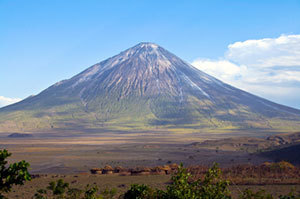
      <![CDATA[<p class="image-right"><img title="Ol Doinyo Lengai, Tanzania" src="http://news.nd.edu/assets/117905/oldoinyo_lengai_300.jpg" alt="Ol Doinyo Lengai, Tanzania"> Ol Doinyo Lengai, Tanzania</p>
<p>A new discovery by researchers from the University of Notre Dame’s <a href="http://ceees.nd.edu/">Department of Civil and Environmental Engineering and Earth Sciences</a> could change prevailing assumptions about the chemical makeup of the Earth’s mantle.</p>
<p><a href="http://engineering.nd.edu/profiles/asimonetti">Antonio Simonetti</a>, an associate professor in the department, and his doctoral student <a href="http://engineering.nd.edu/profiles/wchen2">Wei Chen</a> worked in cooperation with Vadim Kamenetsky of the University of Tasmania, Hobart (Australia) to learn the art of conducting chemical and mineralogical analyses of melt inclusions within crystals of the mineral magnetite (Fe3O4).</p>
<p>Simonetti points out that the magnetite crystals are hosted within igneous rocks (rocks resulting from the melting of the Earth’s mantle) referred to as carbonatites.</p>
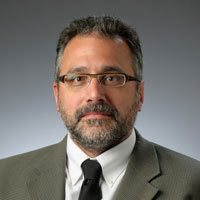
<p class="image-left"><img title="Antonio Simonetti" src="http://news.nd.edu/assets/117901/antonio_simonetti_200x.jpg" alt="Antonio Simonetti"> Antonio Simonetti</p>
<p>“The latter are an exceptional and intriguing type of igneous rock since they are composed primarily of calcium carbonate, or Calcite-CaCO3, rather than silicate minerals, which are the predominant minerals in the Earth’s crust and oceanic rocks,” Simonetti said. “Despite the small number of carbonatite occurrences worldwide compared to their volcanic counterparts in the past and present day, carbonatites continue to receive considerable deserved attention because of their unique enrichment, relative to crustal abundances in incompatible trace elements, such as niobium and the rare Earth elements.”</p>
<p>To date, most of the geological community believed that the sodium- and potassium-rich magmas being erupted at the Earth’s sole active carbonatite volcano at Ol Doinyo Lengai in Tanzania were unique, since all other carbonatite occurrences worldwide are dominated by calcium-rich carbonate or calcite.</p>
<p>In an attempt to resolve this question, Wei sought to determine the initial melt composition that gave rise to the Oka carbonatite complex, which is located in southeastern Quebec.</p>
<p>“We approached this issue by examining the nature and chemical composition of melt inclusions within individual magnetite crystals present in carbonatites,” Simonetti said. “Melt inclusions are micron-sized ‘pockets’ present within minerals that represent a combination or mechanical mixture of co-trapped crystals and melt engulfed and isolated early in the crystallization history of the magma while the magnetite crystals were forming. Hence, investigating melt inclusions represents a powerful tool for determining the chemical composition of the initial carbonatite magma at the Oka complex.”</p>
<p>Wei and Simonetti’s research revealed that the chemical composition of minerals trapped within the melt inclusions at the Oka complex are alkaline in nature and similar in composition to the minerals present at Ol Doinyo Lengai volcano. The finding will have a major impact in relation to deciphering and modeling chemical processes taking place in the Earth’s mantle throughout geologic time.</p>
<p>“This has some significant consequences as to how earth scientists should view the overall chemical budget of the Earth’s mantle since this is where carbonatite magmas are produced,” Simonetti said. “We are not attributing enough alkalies in the region of the mantle where carbonitite melts form.”</p>
<p>In addition to its significance for the field of earth science, the finding also has important practical and strategic importance. Carbonatites are of critical importance in the continually evolving fields of superconductors, electronics and computing. Several countries such as the <span class="caps">USA</span>, China, Brazil and Canada are host to carbonatite occurrences, and there is active exploration in many of these countries to locate new deposits given the ever-increasing demand for the manufacturing of sophisticated electronic components.</p>
<p>The paper describing Wei and Simonetti’s research appears in the journal <a href="http://www.nature.com/ncomms/2013/131030/ncomms3687/full/ncomms3687.html">Nature Communications</a>.</p>
<p><em><strong>Contact</strong>: Antonio Simonetti, <a href="mailto:simonetti.3@nd.edu">simonetti.3@nd.edu</a></em></p>
<p class="attribution">Originally published by <span class="rel-author">William G. Gilroy</span> at <span class="rel-source"><a href="http://news.nd.edu/news/44237-notre-dame-geologists-discovery-should-cause-earth-scientists-to-rethink-chemical-makeup-of-earths-mantle/">news.nd.edu</a></span> on <span class="rel-pubdate">November 11, 2013</span>.</p>]]>
    </content>
    <author>
      <name>William G. Gilroy</name>
    </author>
  </entry>
  <entry>
    <id>tag:simonettilab.nd.edu,2005:News/171655</id>
    <published>2011-02-15T15:29:00-05:00</published>
    <updated>2025-04-14T15:29:49-04:00</updated>
    <link rel="alternate" type="text/html" href="https://simonettilab.nd.edu/news/researcher-simonetti-coauthors-important-new-dinosaur-dating-paper/"/>
    <title>Researcher Simonetti coauthors important new dinosaur-dating paper</title>
    <summary type="text">
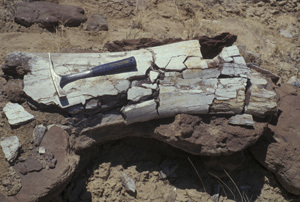
      <![CDATA[p(image-right). !https://news.nd.edu/assets/37060/dinobonesample_bb1.jpg(Alamosaurus Sanuanensis Femur)! Antonio Simonetti, a research associate professor in the "Department of Civil Engineering and Geological Sciences":http://www.nd.edu/~cegeos/index.html at the University of Notre Dame, is the coauthor of an important new paper describing a novel method for age dating dinosaur fossils. "Simonetti":http://www.nd.edu/~cegeos/people/faculty-pages/simonetti.html and colleagues from the University of Alberta used a U-Pb (uranium-lead) dating technique to analyze a fossilized dinosaur bone discovered in New Mexico. In a paper in the prestigious journal "Geology":http://geology.gsapubs.org/content/39/2/159.abstract, the researchers discuss their method and reveal that it determined that the femur bone from a giant hadrosaur dinosaur was 64.8 million years old.]]>
    </summary>
    <content type="html">
      <![CDATA[<p class="image-right"><img title="Alamosaurus Sanuanensis Femur" src="https://news.nd.edu/assets/37060/dinobonesample_bb1.jpg" alt="Alamosaurus Sanuanensis Femur"></p>
<p>Antonio Simonetti, a research associate professor in the <a href="http://www.nd.edu/~cegeos/index.html">Department of Civil Engineering and Geological Sciences</a> at the University of Notre Dame, is the coauthor of an important new paper describing a novel method for age dating dinosaur fossils.</p>
<p><a href="http://www.nd.edu/~cegeos/people/faculty-pages/simonetti.html">Simonetti</a> and colleagues from the University of Alberta used a U-Pb (uranium-lead) dating technique to analyze a fossilized dinosaur bone discovered in New Mexico. In a paper in the prestigious journal <a href="http://geology.gsapubs.org/content/39/2/159.abstract">Geology</a>, the researchers discuss their method and reveal that it determined that the femur bone from a giant hadrosaur dinosaur was 64.8 million years old.</p>
<p class="image-left"><img title="Antonio Simonetti" src="https://news.nd.edu/assets/23748/simonetti_rel.jpg" alt="Antonio Simonetti"></p>
<p>The finding has caused a significant stir in scientific circles. There has been wide agreement among paleontologists that dinosaurs became extinct roughly 65.5 million years ago. Various theories as to the cause of this extinction have been suggested, ranging from a huge asteroid striking the earth to changes in global sea levels and climate to sustained periods of volcanism.</p>
<p>However, the method used by Simonetti and his colleagues determined that the New Mexico plant eating dinosaur was alive roughly 700,000 years after the surmised giant extinction event.</p>
<p>Although the challenge to the accepted dinosaur extinction model has received the most attention, Simonetti believes that the dating method described in the paper is especially significant.</p>
<p>The current method paleontologists use to date dinosaur fossils is a technique called relative chronology. The method estimates a fossil’s age relative to the known age of deposits of sediment in which it was found.</p>
<p>However, the relative chronology technique does not take into account the possibility that millions of years of geological and environmental activity can cause a fossil to drift from its original position in a layer of sediment and be re-deposited in a younger sediment layer.</p>
<p>The U-Pb method Simonetti and his Alberta colleagues employed uses a laser beam to sample minute particles of the fossil, which are then subjected to isotopic analysis using state-of-the-art instrumentation.</p>
<p>Simonetti and his colleagues believe that if the uranium-lead dating technique is confirmed in additional fossil samples, prevailing theories about the end of the dinosaurs will need to be revised.</p>
<p>And much of that dating work will be done in a new laboratory facility at Notre Dame. Simonetti and <a href="http://www.nd.edu/~cegeos/people/faculty-pages/neal.html">Clive R. Neal</a>, a professor of civil engineering and geological sciences, have received a National Science Foundation-<span class="caps">MRI</span> equipment grant to establish “MITERAC” — the Midwest Isotope and Trace Element Research Analytic Center — in Cushing Hall. The facility will expand the research endeavors of 18 researchers from six universities in Indiana and Michigan, including some who will use the facility for the new uranium-lead dating technique.</p>
<p><em><strong>Contact</strong>: Antonio Simonetti, 574-631-6710, <a href="mailto:simonetti.3@nd.edu">simonetti.3@nd.edu</a></em></p>
<p class="attribution">Originally published by <span class="rel-author">William G. Gilroy</span> at <span class="rel-source"><a href="https://news.nd.edu/news/researcher-simonetti-coauthors-important-new-dinosaur-dating-paper/">news.nd.edu</a></span> on <span class="rel-pubdate">February 15, 2011</span>.</p>]]>
    </content>
    <author>
      <name>William G. Gilroy</name>
    </author>
  </entry>
</feed>